


Sanctions are one of the most actively debated topics in the fields of international law and international relations. They constitute a cross-disciplinary subject covering a wide range of issues, including human rights, the effectiveness of sanctions, the proportionality of measures, how targeted or “smart” these restrictions are, and the differences between unilateral and international sanctions.
Certainly, all of these issues are crucial for academic debate. Yet one important element, sanctions data, is often overlooked or only rarely present in scholarly discussions. Observing this gap, B. Bertatskyi decided to develop a platform, Sanctions Finder, that allows scholars and NGO practitioners to work directly with sanctions data.
As a researcher at Vilnius University, he focuses on how sanctions data can be used effectively in academic research and studies. Currently, up to 10 sanctions datasets are available in the literature, which are essential for examining sanctions both qualitatively and quantitatively.
During his fellowship at the university, the researcher launched a new tool on a platform dedicated to sanctioned goods. This platform serves as the first comprehensive source that scholars can utilise for sectoral sanctions data sets. Previous datasets primarily focused on specific episodes or incidents, but this platform allows researchers to analyse the scope, numbers, dynamics, and trends of sanctions rather than just capturing particular periods. Additionally, researchers can examine the number of delistings, compare the reasons for imposed sanctions, analyse the typical roles and positions of designated individuals, and much more.
With the support of Vilnius University, the sanctions dataset prepared by B. Bernatskyi was presented at the MINOS Sanctions Methods Course in 2026, held in June at the Geneva Graduate Institute.
How it works: Finder provides access to first-hand sanctions data from the United States, the United Kingdom, the European Union, and Canada virtually in one click, allowing users to focus only on the information relevant to their particular area of work. For instance, there is an ongoing debate about which sanctions regime is the most comprehensive and which parameters or indicators should be used to assess the scale of the measures adopted. Using Sanctions Finder, researchers have access to a wide range of quantitative indicators suitable for such assessments, including the number of listed persons and entities under a particular regime and, subject to sectoral measures, the number of sanctioned goods.
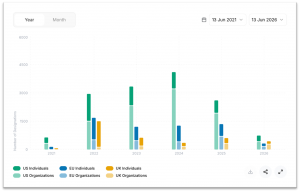
Since the full-scale invasion of Ukraine, the number of sanctions has increased several times (see the comparison between 2021 and 2026).
An interesting comparison can be made between the sanctions regimes imposed on Belarus and Russia by the European Union, even though their overall objectives are similar. The EU has listed approximately 2,000 different goods under the Belarus regime and more than 2,500 items under the Russia regime. On the other hand, sanctions imposed pursuant to UN Security Council resolutions against Iran and the DPRK contain a comparable number of listed goods. However, while many goods on the High Priority List are prohibited from export to Iran, Russia, and Belarus, equivalent restrictions do not necessarily apply under the DPRK sanctions regime.
Added value for research: using data from Sanctions Finder can enrich sanctions studies by providing more precise and objective information. In many cases, researchers face difficulties identifying objective indicators for evaluating sanctions policies. Quantitative data can provide valuable guidance and greater precision when addressing questions such as what constitutes a proportionate delisting policy in light of the total number of listed entities, or what gaps exist in anti-circumvention strategies when comparing the effectiveness and workability of the Belarus and Russia sanctions regimes.
I would also encourage students and academic fellows engaged in legal research to explore this resource. It may prove useful not only for academic purposes but also for careers related to sanctions compliance, due diligence, and risk assessment. More broadly, it can serve as a practical introduction to one of the most dynamic and promising areas of contemporary legal practice.
Dr. Bohdan Bernatskyi, Research Fellow at the Vilnius University (academic supervisor assoc. prof. dr. Indrė Isokaitė)